Posts

MICROBIAL METABOLISM CONTD...

Image
FERMENTATION : In the absence of aerobic or anaerobic respiration, NADH is not oxidized by the electron transport chain because no external electron acceptor is available. Yet NADH produced in the glycolytic pathway during the oxidation of glyceraldehyde 3-phosphate to 1,3-bisphosphoglycerate  must still be oxidized back to NAD . If NAD is not regenerated, the oxidation of glyceraldehyde 3-phosphate will cease and glycolysis will stop. Many microorganisms solve this problem by slowing or stopping pyruvate dehydrogenase activity and using pyruvate or one of its derivatives as an electron and hydrogen acceptor for the reoxidation of NADH in a fermentation process . This may lead to the production of more ATP. The process is so effective that some chemoorganoheterotrophs do not carry out respiration even when oxygen or another exogenous acceptor is available. There are many kinds of fermentations, and they often are characteristic         ...

MICROBIAL METABOLISM CONTD..

Image
ELECTRON TRANSPORT CHAIN : The mitochondrial electron transport chain is composed of a series of electron carriers that operate together to transfer electrons from donors, like NADH and FADH2, to acceptors, such as O2.  The electrons flow from carriers with more negative reduction potentials to those with more positive potentials and eventually combine with O2 and H to form water. This pattern of electron flow is exactly the same as seen in the electron tower that was described in chapter 8 (see figure 8.7). The electrons move down this potential gradient much like water flowing down a series of rapids. The difference in reduction potentials between O2 and NADH is large, about 1.14 volts, and makes possible the release of a great deal of energy. The potential changes at several points in the chain are large enough to provide sufficient energy for ATP production, much like the energy from waterfalls can be harnessed by waterwheels and used to generate electricity...

MICROBIAL METABOLISM CONTD..

Image
TRICARBOXYLIC ACID CYCLE/ KREBS CYCLE/ CITRIC ACID CYCLE: Although some energy is obtained from the breakdown of glucose to pyruvate by the pathways previously described, much more is released when pyruvate is degraded aerobically to CO2 in stage three of catabolism. The multienzyme system called the pyruvate dehydrogenase complex first oxidizes pyruvate to form CO2 and acetyl coenzyme A (acetyl-CoA), an energy-rich molecule composed of coenzyme A and acetic acid joined by a highenergy thiol ester bond . Acetyl-CoA arises from the catabolism of many carbohydrates, lipids, and amino acids .  It can be further degraded in the tricarboxylic acid cycle. The substrate for the tricarboxylic acid (TCA) cycle, citric acid cycle, or Krebs cycle is acetyl-CoA . The traditional way to think about the cycle is in terms of its intermediates and products, and the chemistry involved in each step. In the first reaction acetyl-CoA is condensed with a fourcarbon intermedi...

MICROBIAL METABOLISM CONTD....

Image
ED PATHWAY ( ALTERNATIVE TO GLYCOLYSIS)    Although the glycolytic pathway is the most common route for the conversion of hexoses to pyruvate, another pathway with a similar role has been discovered. The Entner-Doudoroff pathway begins with the same reactions as the pentose phosphate pathway, the formation of glucose 6-phosphate and 6-phosphogluconate .Instead of being further oxidized, 6- phosphogluconate is dehydrated to form 2-keto-3-deoxy-6- phosphogluconate or KDPG, the key intermediate in this pathway. KDPG is then cleaved by KDPG aldolase to pyruvate and glyceraldehyde 3-phosphate. The glyceraldehyde 3-phosphate is converted to pyruvate in the bottom portion of the glycolytic pathway. If the Entner-Doudoroff pathway degrades glucose to pyruvate in this way, it yields one ATP, one NADPH, and one NADH per glucose metabolized. Most bacteria have the glycolytic and pentose phosphate pathways, but some substitute the Entner-Doudoroff pathway for glycolysis...

MICROBIAL METABOLISM CONTD...

Image
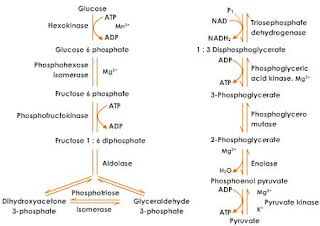
GLYCOLYSIS: Steps:       The Embden-Meyerhof or glycolytic pathway is undoubtedly the most common pathway for glucose degradation to pyruvate in stage two of catabolism. It is found in all major groups of microorganisms and functions in the presence or absence of O2. Glycolysis [Greek glyco, sweet, and lysis, a loosening] is located in the cytoplasmic matrix of procaryotes and eucaryotes. The pathway as a whole may be divided into two parts.  In the initial six-carbon stage, glucose is phosphorylated twice and eventually converted to fructose 1,6- bisphosphate. Other sugars are often fed into the pathway by conversion to glucose 6-phosphate or fructose 6-phosphate. This preliminary stage does not yield energy; in fact, two ATP molecules are expended for each glucose. These initial steps “prime the pump” by adding phosphates to each end of the sugar. The phosphates will soon be used to make ATP. The three-carbon stage of glycolysis begins when the ...

MICROBIAL METABOLISM

Image
Living cells are in a state of ceaseless activity. To maintain its “life,” each cell depends on highly coordinated biochemical reactions. Carbohydrates are an important source of the energy that drives these reactions. This chapter discusses the energy-generating pathways of carbohydrate metabolism are discussed. During glycolysis, an ancient pathway found in almost all organisms, a small amount of energy is captured as a glucose molecule is converted to two molecules of pyruvate. Glycogen, a storage form of glucose in vertebrates, is synthesized by glycogenesis when glucose levels are high and degraded by glycogenolysis when glucose is in short supply. Glucose can also be synthesized from noncarbohydrate precursors by reactions referred to as gluconeogenesis. The pentose phosphate pathway enables cells to convert glucose-6-phosphate, a derivative of glucose, to ribose- 5-phosphate (the sugar used to synthesize nucleotides and nucleic acids) and other types of monosacchar...

MICROBIAL METABOLISM

Image
Metabolism:  Metabolism is the dynamic balance between difference types of reaction( catabolism+ anabolism) that provide the cell with energy or building materials & those to utilize them. It consists of two general activities:  i)  Energy Production                             ii) Energy Utilization  Metabolic pathways are treated as a sequence of enzymes functioning as a unit, with each enzyme using as its substrate a product of the preceding enzyme-catalyzed reaction. This picture of metabolic pathways is incomplete because we will usually ignore the regulation of pathway operation for the sake of space and simplicity. However, one should keep in mind that both regulation of the activity of individual pathways and coordination of the action of separate sequences are essential to the existence of life. Cells become disorganized and die without adequate control of metabolism,...